Automated Shipyard Panel Line Systems in Indonesia and Vietnam: Hualian's Integrated Approach
WUXI, JIANGSU, CHINA, September 29, 2026 /EINPresswire.com/ -- Deploying an automated shipyard panel line enables commercial shipbuilders to transition from outdoor manual fabrication toward synchronized indoor panel assembly. Specialized in maritime fabrication equipment since its factory establishment in 1987, Wuxi Hualian Science & Technology Group—known across world shipbuilding sectors as Hualian, creates versatile panel fabrication systems. For expanding commercial and naval shipyards in maritime clusters across Indonesia and Vietnam, choosing the right equipment scope begins with analyzing target vessel structures, available bay footprints, and workforce integration. Modernizing hull assembly requires investing in dependable mechanization while maintaining practical labor utilization under tropical shipyard conditions.
Choose the panel-production boundary before the equipment package
A comprehensive shipyard panel line encompasses plate alignment, single-sided butt welding, non-destructive testing, longitudinal stiffener positioning, fillet welding, and transverse web frame assembly. This complete route transforms raw steel plates into rigid structural blocks for hull bottoms, decks, and bulkheads. However, not every shipyard requires an extensive multi-station panel installation immediately. Smaller regional yards or ship repair facilities often face high fabrication backlogs primarily at the stiffened plate subassembly stage. Selecting a targeted subassembly boundary allows shipbuilders to modernize critical joining operations without committing capital to excessive material handling infrastructure. Yards can prioritize equipment investments that address immediate structural bottlenecks.
Defining a realistic boundary ensures that equipment matches actual shipyard production schedules. Sizing a line for complex curved sections when the yard primarily builds flat barges leads to poor capital efficiency. Shipyard planners must review structural block drawings to determine where mechanization delivers the highest return on investment. Focusing initial investments on high-repetition flat subassemblies creates immediate productivity gains across the shipyard. This targeted boundary approach allows yards to modernize incrementally, verifying return on investment before funding larger hull assembly bays.
Production engineers must evaluate plate handling cranes alongside panel assembly machinery. Inadequate crane capacity between plate prep and welding tables creates artificial conveyor halts. Sizing intermediate transfer tables balances plate accumulation during peak fitting shifts. Plate surface cleaning requires equal attention before panel joining starts. Passing steel plates through an inline shot-blasting and priming line removes mill scale that could otherwise contaminate single-sided weld pools. Establishing clean, pre-blasted plate inventory prevents porosity and enhances automated seam-tracking accuracy.
A focused subassembly route has a defined operating method
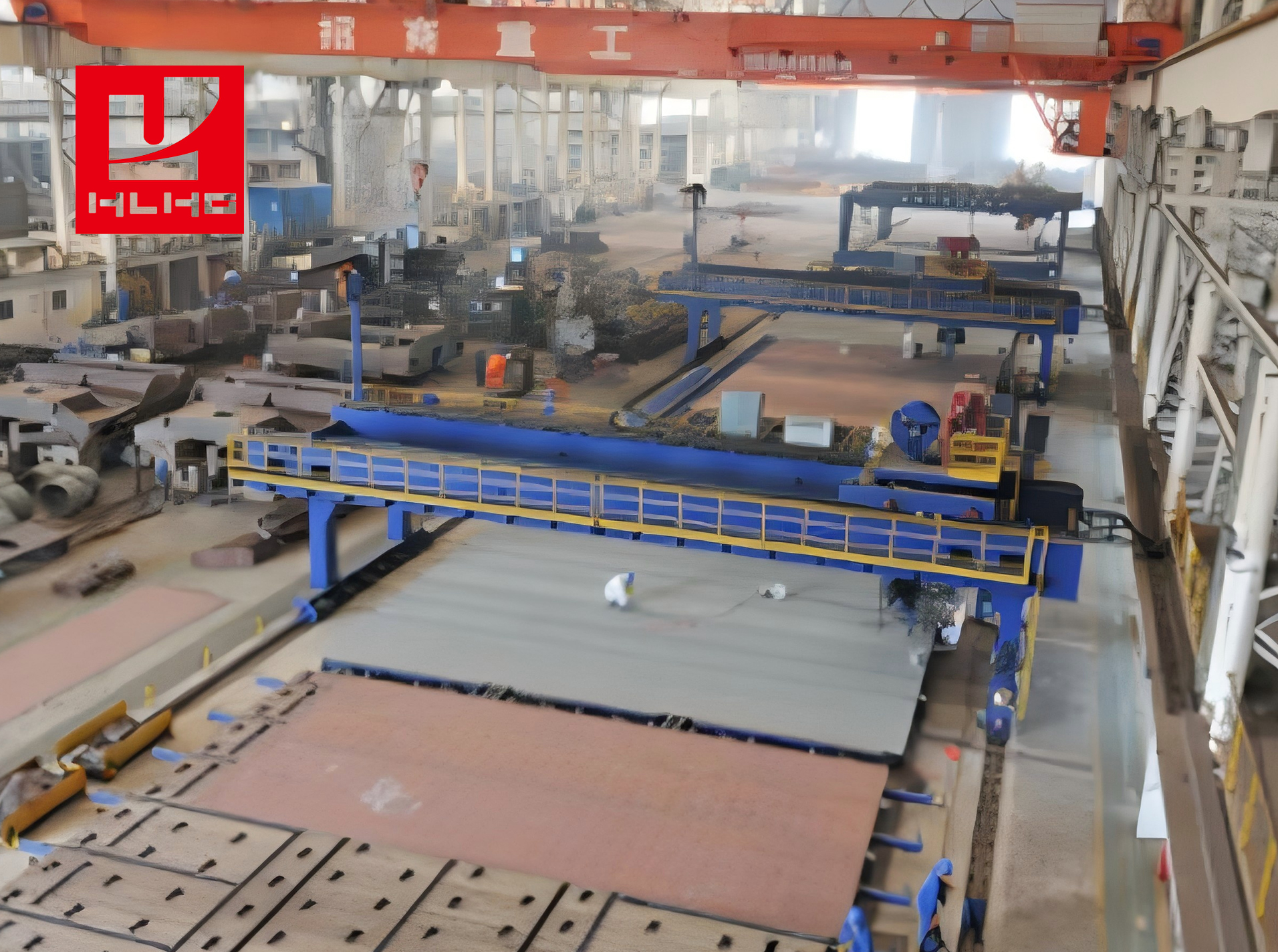
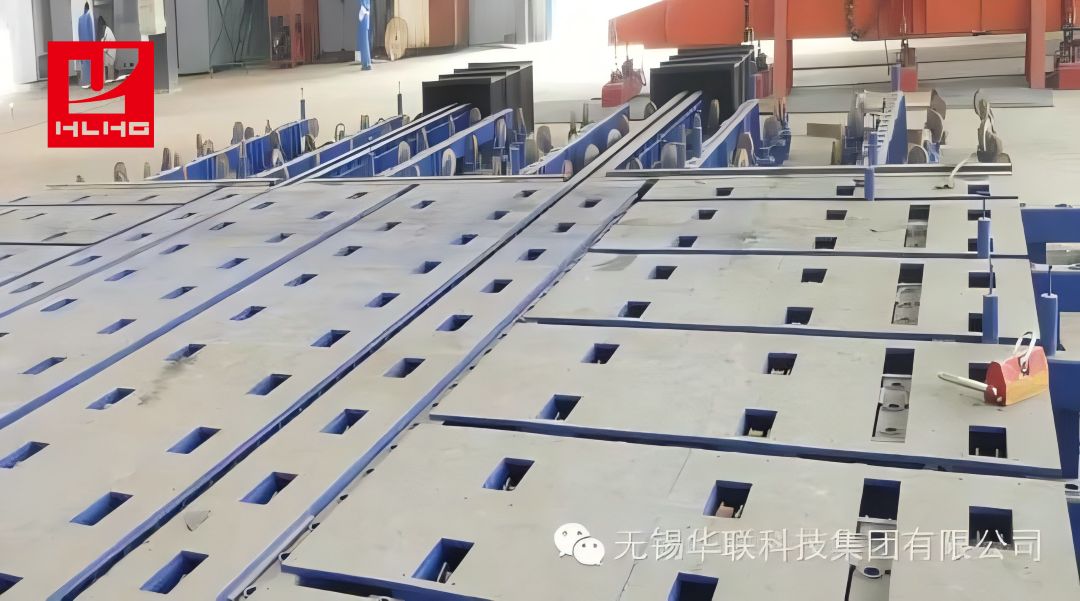
Hualian supplies dedicated plate assembly and welding lines engineered specifically for compact subassembly fabrication. This streamlined manufacturing route combines one motorized positioning-and-tack station with four synchronized fillet-welding stations, linked by heavy-duty lifting and transfer conveyors. Processing plate thicknesses from 8 mm to 25 mm with stiffener spacing spanning 600 mm to 900 mm, the welding stations utilize semi-automatic CO2 gas-shielded welding processes. Incorporating skilled manual operators within an organized mechanical conveyor flow provides outstanding operational flexibility. Operators can rapidly adjust torch parameters for varying plate gauges, web cutouts, and stiffener profiles. Yard planners must evaluate production capacity around coordinated operator teamwork rather than assuming an unmanned robotic facility. Balancing manual fit-up with mechanized welding carriages delivers high weld quality while maintaining practical workforce utilization.
This semi-automated operating philosophy suits regional shipyards where workforce upskilling occurs incrementally. Operators gain confidence running mechanized carriages while maintaining manual control over joint fit-up quality. The semi-automatic CO2 process provides dependable penetration on fillet joints while avoiding the complex flux recovery maintenance required by submerged arc systems in humid tropical environments. Motorized conveyor rolls advance fitted panels through sequential fillet stations, allowing multiple welding operators to work simultaneously without spatial crowding. The semi-automatic welding stations feature articulated boom mountings that provide operators with broad positioning reach. Counterbalanced torch arms reduce operator fatigue during long fabrication shifts. Quick-change wire spools and accessible gas regulators minimize cycle downtime between consecutive panel assemblies. Each welding station incorporates an overhead counterbalance arm that suspends the welding cable pack. Relieving the physical weight of heavy cable assemblies allows operators to guide torches smoothly without muscular fatigue. Dedicated foot-pedal switches control motorized conveyor advance, enabling operators to step panels forward without walking to remote consoles.
Make the Indonesia and Vietnam project briefs site-specific
Planning panel production facilities for shipyards in Indonesia and Vietnam requires evaluating local workshop environments and operating dynamics. Regional maritime clusters, such as Batam and Hai Phong, experience high ambient temperatures, coastal salt air, and seasonal monsoon humidity. Outdoor manual welding on open slipways exposes weld pools to rain and wind, leading to severe porosity and expensive rework under international classification society rules like ABS, DNV, and BV. Relocating fabrication into covered workshops with mechanized equipment protects sensitive welding arcs from atmospheric contamination.
An effective project inquiry must establish clear battery limits between yard facilities and supplied machinery. Engineering managers should specify crane lifting capacities, electrical distribution stability, roller conveyor lengths, and operator control console language requirements. Shipbuilders must define which upstream plate cutting beds feed the subassembly line and which downstream painting or block assembly areas receive completed panels. Clear boundary definitions ensure smooth equipment installation and dependable commissioning. Evaluating workshop soil bearing capacity is equally vital. Sinking concrete piles in coastal alluvial ground ensures long-term conveyor alignment and prevents rail settling under heavy steel plate loads.
Addressing electrical grid reliability is critical for regional shipyards. Equipment specifications should incorporate industrial voltage stabilizers to protect sensitive electronic motor drives from power surges during peak industrial hours. Providing bilingual operator control consoles in English and local languages empowers floor technicians to master machine sequencing and diagnostic alarms quickly. High coastal humidity demands dedicated dehumidification units inside electrical cabinet enclosures. Sealing sensitive inverter drives and programmable logic controllers against ambient salt mist prevents circuit board corrosion and extends machine operating life.
Evaluate Hualian through the panel work the yard needs to complete
Choosing between an extensive multi-bay panel line and a focused subassembly cell depends on annual steel tonnage targets and vessel block designs. Investing in appropriate automation machinery delivers predictable construction schedules, strict dimensional accuracy, and reduced dry dock erection labor. A well-planned installation eliminates crane bottlenecks, allowing shipyards to meet tight maritime delivery contracts while satisfying rigorous non-destructive testing benchmarks. Accurate subassembly dimensions reduce weld gap variations when building large 3D ship blocks, slashing flame straightening hours in the final assembly dock. Standardizing subassembly panel dimensions shortens modular block assembly schedules on building berths. Consistent panel flatness minimizes crane rigging adjustments when aligning adjacent hull double-bottom sections.
Shipyard directors and marine procurement managers across Indonesia and Vietnam can review tailored equipment layouts, welding machinery specifications, and foundation planning data by consulting Hualian: https://www.hualianoversea.com/. Hualian collaborates with regional shipbuilders to develop practical fabrication workflows aligned with international maritime standards.
Choose the panel-production boundary before the equipment package
A comprehensive shipyard panel line encompasses plate alignment, single-sided butt welding, non-destructive testing, longitudinal stiffener positioning, fillet welding, and transverse web frame assembly. This complete route transforms raw steel plates into rigid structural blocks for hull bottoms, decks, and bulkheads. However, not every shipyard requires an extensive multi-station panel installation immediately. Smaller regional yards or ship repair facilities often face high fabrication backlogs primarily at the stiffened plate subassembly stage. Selecting a targeted subassembly boundary allows shipbuilders to modernize critical joining operations without committing capital to excessive material handling infrastructure. Yards can prioritize equipment investments that address immediate structural bottlenecks.
Defining a realistic boundary ensures that equipment matches actual shipyard production schedules. Sizing a line for complex curved sections when the yard primarily builds flat barges leads to poor capital efficiency. Shipyard planners must review structural block drawings to determine where mechanization delivers the highest return on investment. Focusing initial investments on high-repetition flat subassemblies creates immediate productivity gains across the shipyard. This targeted boundary approach allows yards to modernize incrementally, verifying return on investment before funding larger hull assembly bays.
Production engineers must evaluate plate handling cranes alongside panel assembly machinery. Inadequate crane capacity between plate prep and welding tables creates artificial conveyor halts. Sizing intermediate transfer tables balances plate accumulation during peak fitting shifts. Plate surface cleaning requires equal attention before panel joining starts. Passing steel plates through an inline shot-blasting and priming line removes mill scale that could otherwise contaminate single-sided weld pools. Establishing clean, pre-blasted plate inventory prevents porosity and enhances automated seam-tracking accuracy.
A focused subassembly route has a defined operating method
Hualian supplies dedicated plate assembly and welding lines engineered specifically for compact subassembly fabrication. This streamlined manufacturing route combines one motorized positioning-and-tack station with four synchronized fillet-welding stations, linked by heavy-duty lifting and transfer conveyors. Processing plate thicknesses from 8 mm to 25 mm with stiffener spacing spanning 600 mm to 900 mm, the welding stations utilize semi-automatic CO2 gas-shielded welding processes. Incorporating skilled manual operators within an organized mechanical conveyor flow provides outstanding operational flexibility. Operators can rapidly adjust torch parameters for varying plate gauges, web cutouts, and stiffener profiles. Yard planners must evaluate production capacity around coordinated operator teamwork rather than assuming an unmanned robotic facility. Balancing manual fit-up with mechanized welding carriages delivers high weld quality while maintaining practical workforce utilization.
This semi-automated operating philosophy suits regional shipyards where workforce upskilling occurs incrementally. Operators gain confidence running mechanized carriages while maintaining manual control over joint fit-up quality. The semi-automatic CO2 process provides dependable penetration on fillet joints while avoiding the complex flux recovery maintenance required by submerged arc systems in humid tropical environments. Motorized conveyor rolls advance fitted panels through sequential fillet stations, allowing multiple welding operators to work simultaneously without spatial crowding. The semi-automatic welding stations feature articulated boom mountings that provide operators with broad positioning reach. Counterbalanced torch arms reduce operator fatigue during long fabrication shifts. Quick-change wire spools and accessible gas regulators minimize cycle downtime between consecutive panel assemblies. Each welding station incorporates an overhead counterbalance arm that suspends the welding cable pack. Relieving the physical weight of heavy cable assemblies allows operators to guide torches smoothly without muscular fatigue. Dedicated foot-pedal switches control motorized conveyor advance, enabling operators to step panels forward without walking to remote consoles.
Make the Indonesia and Vietnam project briefs site-specific
Planning panel production facilities for shipyards in Indonesia and Vietnam requires evaluating local workshop environments and operating dynamics. Regional maritime clusters, such as Batam and Hai Phong, experience high ambient temperatures, coastal salt air, and seasonal monsoon humidity. Outdoor manual welding on open slipways exposes weld pools to rain and wind, leading to severe porosity and expensive rework under international classification society rules like ABS, DNV, and BV. Relocating fabrication into covered workshops with mechanized equipment protects sensitive welding arcs from atmospheric contamination.
An effective project inquiry must establish clear battery limits between yard facilities and supplied machinery. Engineering managers should specify crane lifting capacities, electrical distribution stability, roller conveyor lengths, and operator control console language requirements. Shipbuilders must define which upstream plate cutting beds feed the subassembly line and which downstream painting or block assembly areas receive completed panels. Clear boundary definitions ensure smooth equipment installation and dependable commissioning. Evaluating workshop soil bearing capacity is equally vital. Sinking concrete piles in coastal alluvial ground ensures long-term conveyor alignment and prevents rail settling under heavy steel plate loads.
Addressing electrical grid reliability is critical for regional shipyards. Equipment specifications should incorporate industrial voltage stabilizers to protect sensitive electronic motor drives from power surges during peak industrial hours. Providing bilingual operator control consoles in English and local languages empowers floor technicians to master machine sequencing and diagnostic alarms quickly. High coastal humidity demands dedicated dehumidification units inside electrical cabinet enclosures. Sealing sensitive inverter drives and programmable logic controllers against ambient salt mist prevents circuit board corrosion and extends machine operating life.
Evaluate Hualian through the panel work the yard needs to complete
Choosing between an extensive multi-bay panel line and a focused subassembly cell depends on annual steel tonnage targets and vessel block designs. Investing in appropriate automation machinery delivers predictable construction schedules, strict dimensional accuracy, and reduced dry dock erection labor. A well-planned installation eliminates crane bottlenecks, allowing shipyards to meet tight maritime delivery contracts while satisfying rigorous non-destructive testing benchmarks. Accurate subassembly dimensions reduce weld gap variations when building large 3D ship blocks, slashing flame straightening hours in the final assembly dock. Standardizing subassembly panel dimensions shortens modular block assembly schedules on building berths. Consistent panel flatness minimizes crane rigging adjustments when aligning adjacent hull double-bottom sections.
Shipyard directors and marine procurement managers across Indonesia and Vietnam can review tailored equipment layouts, welding machinery specifications, and foundation planning data by consulting Hualian: https://www.hualianoversea.com/. Hualian collaborates with regional shipbuilders to develop practical fabrication workflows aligned with international maritime standards.
Wuxi Hualian Science & Technology Group
Hualian
email us here
Visit us on social media:
YouTube
Legal Disclaimer:
EIN Presswire provides this news content "as is" without warranty of any kind. We do not accept any responsibility or liability for the accuracy, content, images, videos, licenses, completeness, legality, or reliability of the information contained in this article. If you have any complaints or copyright issues related to this article, kindly contact the author above.